
For homeowners, trees represent a living legacy—a blend of architectural majesty and environmental utility. They frame our houses, shield us from the summer sun, and provide a habitat for local wildlife. However, unlike the inanimate structures of our homes, trees are dynamic organisms that are constantly responding to their environment, aging, and occasionally succumbing to disease or structural failure. Because trees grow on a different time scale than humans, their decline is often slow and subtle, making it easy to overlook until a crisis occurs. A tree that looks magnificent from a distance may be harboring internal rot or structural cracks that make it a high-altitude hazard. Recognizing the “silent signals” of tree distress is essential for protecting your property, your family, and your financial investment. This comprehensive guide explores the critical indicators that your trees need professional intervention and why delaying care can lead to catastrophic results.
Noticing Dead or Falling Branches Around the Property
One of the most obvious signs that a tree is struggling is the presence of “self-pruning” or “clausal” shedding. While it is perfectly normal for a tree to drop small twigs during a high-wind event, the consistent accumulation of large, brittle branches on your lawn is a significant warning sign. Deadwood occurs when the tree is no longer able to transport water and nutrients to its outer extremities. This can be caused by localized fungal infections, insect infestations like the Emerald Ash Borer, or simply the natural senescence of an aging specimen.
If you look up into the canopy and see “ghost branches”—limbs that remain bare and brown while the rest of the tree is in full, vibrant leaf—the tree is already in a state of partial failure. These dead limbs are unpredictable; they lack the flexibility of living wood and can snap under the weight of a light snow or even on a perfectly still, hot summer day. In these instances, you must secure reliable tree removal or pruning services. Removing deadwood is not merely an aesthetic choice; it is a critical safety measure. By removing these “widow-makers,” you reduce the vertical weight on the tree’s main trunk and eliminate the air-resistance “sails” that can cause a tree to uproot during a storm.
Seeing Signs of Disease or Decay in Tree Bark
A tree’s bark is its primary defense system—a biological armor that protects the delicate vascular tissue (the cambium) from bacteria, fungi, and pests. When that armor begins to fail, the entire organism is at risk. Signs of bark distress include “deep cankers” (sunken areas of dead bark), flaking in large, unnatural sheets, or the presence of “weeping” sores where sap or liquid is oozing from the trunk. Furthermore, the presence of shelf-like fungi or mushrooms growing at the base of the trunk (the root flare) is a dire indicator that the structural roots are rotting beneath the soil.
Consulting a reputable tree business for a comprehensive health assessment is the first step in determining if the tree can be saved or if it must be removed. In many cases, internal decay can go undetected for years because the exterior of the tree remains green. Professionals use specialized tools like “resistographs” or sonic tomography to see inside the trunk without harming the tree. If the heartwood—the structural core of the tree—has been hollowed out by rot, the tree loses its ability to withstand wind loads. Identifying these “hollow” threats early allows for a controlled removal before the tree chooses its own, potentially destructive, time to fall.
Observing Trees Leaning More Than Usual
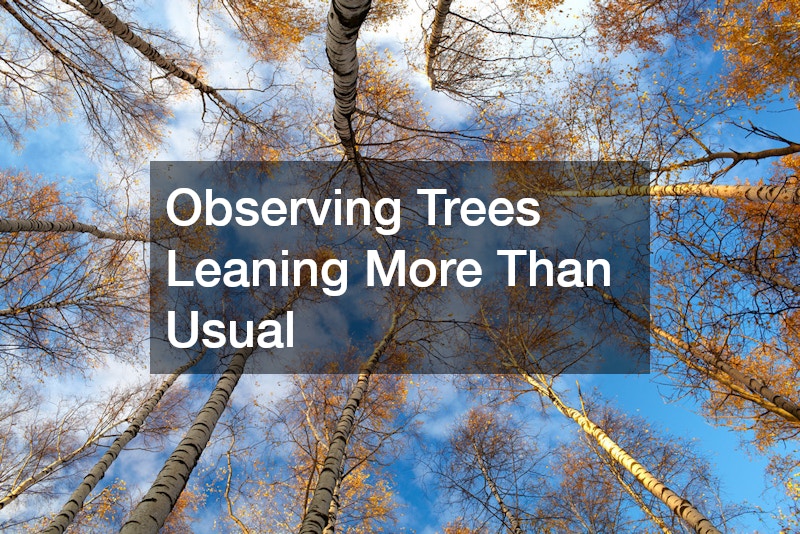
It is a common misconception that every leaning tree is a danger. Many trees naturally grow at an angle as they “hunt” for sunlight in a crowded canopy. However, there is a fundamental difference between a tree that has grown at a lean and a tree that has started to lean. A sudden change in the angle of a tree, especially after a heavy rain or wind storm, is a sign of “root heave” or soil failure. If you notice a mound of soil rising on the side opposite the lean, or if there is a gap appearing between the trunk and the soil, the root system is physically pulling out of the earth.
When a tree begins to tip, it becomes a problem of mechanical leverage. As the angle increases, gravity exerts more force on the root system, making a total collapse inevitable. In these high-risk scenarios, local tree removals are often the only responsible solution. A leaning tree is essentially a falling tree in slow motion. Professional removal teams are trained to handle these unbalanced loads, using complex rigging, cranes, and pulleys to dismantle the tree in sections. This ensures that the descent is controlled and that the falling debris does not strike power lines, neighboring fences, or the roof of your home.
Discovering Cracks or Splits in Large Limbs
Trees are masterpieces of natural engineering, designed to sway and dissipate energy during storms. However, they have specific structural weaknesses, particularly at the “unions” where large limbs attach to the main trunk. If you see a deep, vertical crack in the trunk or a split at a “V-shaped” union (where two large limbs grow tightly together), the tree is structurally compromised. These “included bark” unions are notoriously weak because the two limbs are effectively pushing each other apart as they increase in diameter.
When you discover these structural splits, it is time to consult with professional tree removal companies. While some high-value or historical trees can be salvaged using “cabling and bracing”—a method where high-strength steel cables are used to limit the movement of the competing limbs—this is often a temporary solution. If a crack extends through the bark and into the structural wood, the risk of a “catastrophic split” during the next wind event is astronomical. A professional arborist can evaluate the depth of the fissure and determine if the limb can be lightened through pruning or if the entire tree has become too hazardous to remain.
Finding Roots Damaging Sidewalks or Foundations
The root system of a mature tree is far more expansive than most homeowners realize, often extending two to three times the width of the canopy. While we want a robust root system for stability, roots follow the path of least resistance in their search for water and oxygen. In urban environments, this often leads them directly into the “soft” soil beneath sidewalks, driveways, and home foundations. Large surface roots can lift concrete slabs, creating significant tripping hazards, or exert “heaving” pressure against basement walls that leads to structural cracking.
Enlisting a local tree removal company is necessary when the conflict between nature and infrastructure reaches a breaking point. Homeowners often make the mistake of simply cutting the offending roots with a saw, but this is a double-edged sword. Cutting a major structural “anchor” root can destabilize the tree, making it prone to falling toward your house. Furthermore, large root wounds serve as entry points for decay-causing fungi. A professional can help you navigate the “root zone” safely, determining if a specialized “root barrier” can save your concrete or if the tree is simply too large and too close to the house to be maintained safely.
Watching Branches Grow Too Close to Power Lines
As trees mature, their vertical and horizontal spread can bring them into contact with the utility lines that provide power and communication to your neighborhood. This is one of the most dangerous situations in residential tree care. Wet wood and leaves are excellent conductors of electricity; a branch touching a high-voltage line can cause explosive “arcing,” power surges, and localized fires. In some tragic cases, a branch touching a line can even “energize” the ground around the base of the tree, creating a lethal hazard for anyone nearby.
You should never, under any circumstances, attempt to trim branches near power lines yourself—even with long-handled tools. This task requires “Line-Clearance Certified” local tree trimmers who possess the specialized non-conductive equipment and training to work within the “Minimum Approach Distance” of energized lines. These professionals use specific cutting techniques to “train” the tree away from the wires without compromising its health. Regular maintenance trimming prevents these high-voltage emergencies from developing, ensuring your neighborhood stays powered and safe during stormy weather.
Identifying Overgrown Areas That Block Sunlight
Sometimes, a tree doesn’t have to be “sick” to be a problem; it can simply be too successful. Overgrown trees can create a “dense shade” canopy that prevents sunlight from reaching the ground. This leads to the death of turf grass and ornamental shrubs, resulting in soil erosion and a muddy, unappealing landscape. Furthermore, a dense, unpruned canopy prevents airflow, creating a stagnant environment where humidity is trapped, leading to fungal blights, powdery mildew, and leaf spot diseases.
A professional tree trimming service can revitalize your landscape through “canopy thinning” or “crown lifting.” Thinning involves the selective removal of secondary branches to allow dappled sunlight and fresh air to reach the center of the tree and the lawn below. This process doesn’t just benefit your garden; it makes the tree more “wind-firm.” By allowing the wind to pass through the branches rather than hitting the canopy like a solid sail, you reduce the “wind load” on the trunk, making the tree much less likely to uproot during a gale. Thinning is an art form that preserves the tree’s natural silhouette while improving the health of the entire property.
Responding Quickly After Severe Storm Damage
Severe weather is the ultimate stress test for a tree. Lightning strikes can cause “internal boiling” of the sap, literally exploding the bark off the trunk, while heavy ice and wet snow can snap limbs like toothpicks. After a major storm, many trees are left in a state of “suspended failure”—where heavy branches (often called “widow-makers”) are broken but remain caught in the canopy, waiting for a gust of wind to send them crashing down.
In the aftermath of a storm, you need an emergency tree removal team. These specialized crews are equipped with cranes, bucket trucks, and high-capacity chippers to handle trees that have fallen on houses, cars, or blocked vital access roads. Speed and precision are essential in these moments; a fallen tree resting on a roof is a dynamic, unstable load that can shift or settle, causing further structural damage to the home. Emergency professionals prioritize “stabilization” first, neutralizing the immediate threat before proceeding to the complex task of dismantling the debris and cleaning the site.
Recognizing When a Tree Has Become Unsafe
It is a chilling fact that many dangerous trees look perfectly healthy at a glance. A tree can have a full, green canopy while its interior is hollow or its root system is 70% decayed. One subtle sign of “stress signaling” is the appearance of “epicormic sprouts”—small, thin, vertical shoots growing directly out of the main trunk or large limbs. This is the tree’s emergency “survival mode,” indicating that it is struggling to produce enough energy through its main canopy.
If you have a persistent “gut feeling” that a tree is too large for its location, or if its proximity to your home is causing anxiety, it is time to seek a professional risk assessment. A tree removal service can perform a quantitative analysis of the tree’s “Target, Impact, and Probability.” They evaluate what the tree would hit if it fell and how likely that fall is based on the species and its current condition. Sometimes, the most responsible act of property management is the removal of an over-mature or structurally unsound tree before it chooses its own time and direction to fall, thereby protecting your home’s value and your neighbors’ safety.
Consulting Professionals for Long-Term Tree Health
While removal is sometimes a necessity, the primary goal of modern arboriculture is preservation. Trees are long-term assets that require a “preventative medicine” approach. Just as you maintain a relationship with a physician or a mechanic, your trees benefit from a relationship with a dedicated professional who understands the unique challenges of the urban forest, such as soil compaction, restricted root space, and pollution.
An arborist is a specialist trained in the science of planting, caring for, and maintaining individual trees. They provide advanced services such as “deep root fertilization,” which injects nutrients directly into the root zone, and “structural pruning,” which guides the growth of young trees to prevent the V-shaped splits that cause problems later in life. By consulting an arborist once every two years, you can identify microscopic pests like the spotted lanternfly or early signs of Oak Wilt before they become fatal. This proactive partnership ensures that your trees remain the beautiful, safe, and oxygen-producing pillars of your landscape for decades to come.
In conclusion, the health of your trees is inextricably linked to the safety and value of your home. From the first sign of a dead branch to the complex diagnosis of internal rot, staying vigilant is the key to responsible homeownership. Your trees are a living legacy; with the right care, they can provide comfort and beauty for generations. However, when nature signals that a tree’s integrity is compromised, do not hesitate to act. Utilize the expertise of professionals to manage the risks, protect your property, and ensure that your landscape remains a sanctuary of health and safety. Trees are magnificent, but they are also powerful—make sure they are working for you, not against you.